


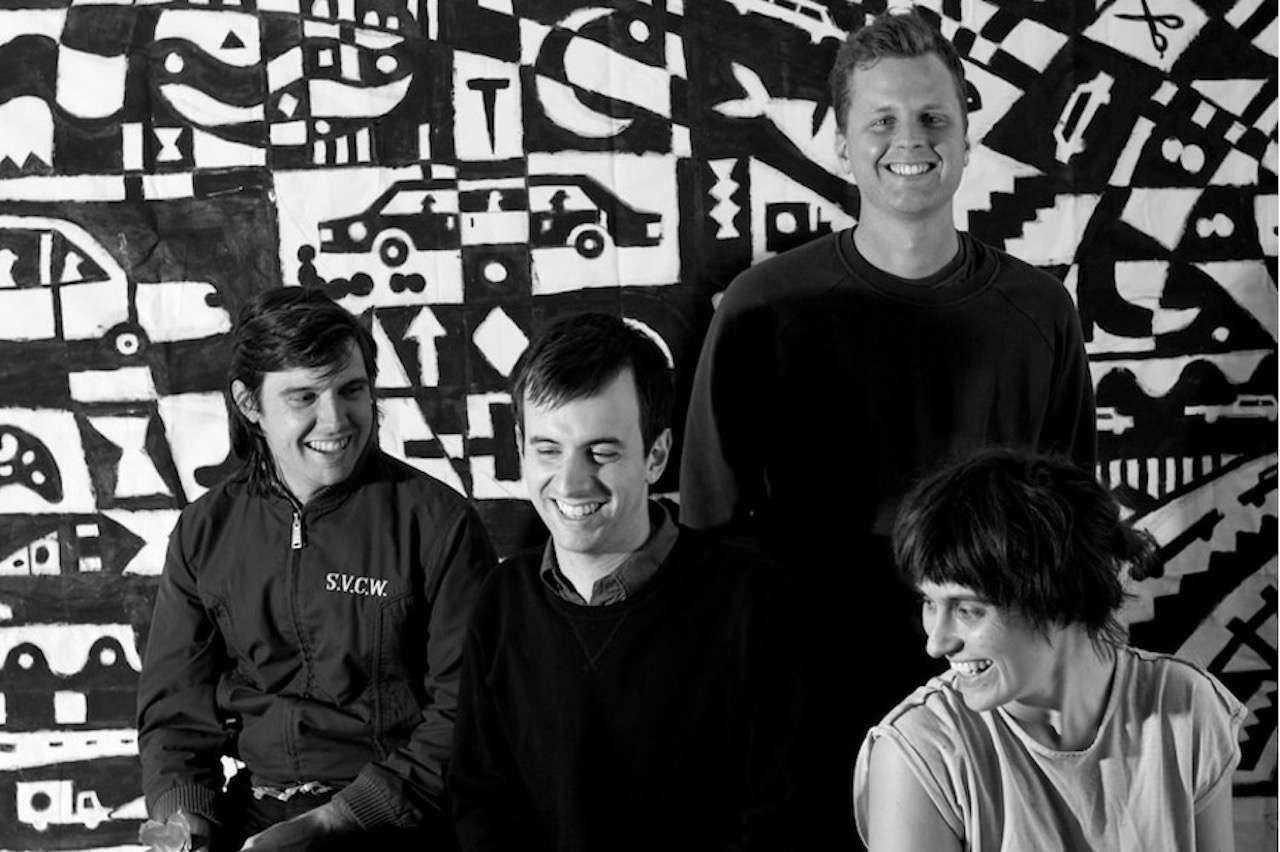
Dick Diver in 2015, Image supplied
Dick Diver performed at Thornbury Theatre, on the lands of the Wurundjeri people of the Kulin Nation, on Friday 1 August.
“I want freedom, the right to self-expression,” wrote anarchist philosopher Emma Goldman in her 1931 autobiography, Living My Life. “[I want] everybody’s right to beautiful, radiant things.”
“There’s no rules / Be yourself,” sang Dick Diver’s Al Montfort in the band’s emancipation anthem, “Head Back,” to the delight of a full house Thornbury Theatre. “Burn the flag.”
It was Dick Diver’s first gig in seven years, and while the audience’s affection was never in doubt, it felt like people were waiting for permission to fully glory in the band’s return. Those words, “burn the flag,” granted this permission – all at once, 700 people erupted into cheers of affirmation, letting Dick Diver know that, scrappy as this comeback gig might have been, it meant the world to see them again.
Throughout the show, Goldman’s disembodied head rotated endlessly on a GIF the band had created as their stage backdrop. The anarchist’s head was superimposed over a brightly coloured photo of the Suez Canal, where a cargo ship was alternately being lifted into the sky and lowered into the water.
“Why the Suez Canal?” asked guitarist and co-lead vocalist Rupert Edwards, responding to a question from the crowd. “Well,” he said, “doesn’t it make you think about global supply chains?”
Dick Diver last played together in 2018, and they haven’t toured since 2015. Edwards’ oblique reference to global supply chains might’ve been a nod to the fact that he lives in Stockholm and the band’s other guitarist and co-lead vocalist, Alistair McKay, spent years based in London. But Dick Diver are also no strangers to sociopolitical commentary.
This is the band that snuck a reference to urban planning in Nazi Germany into a song about an ex-flame moving to Canberra. They started the show with “Keno,” which conveys the perspective of an unhappily married gambling addict. “Alice,” a highlight of the sprawling setlist, is narrated from the perspective of a white Australian “shopping for expanse” in Alice Springs/Mparntwe. While there, enjoying the waterholes and “loving the dust,” a wise local warns them that they “don’t really want to come to the Bronx.”
The band’s debut album, New Start Again, is named after a Centrelink payment. “Something wasn’t working,” drummer and guitarist Steph Hughes sang during the album’s title track, “so I’m on Newstart again.” At the song’s conclusion, Montfort said, “That wasn’t a song about how people are going hungry due to the austerity measures of this Labor government. But that’s also happening.”
This gig – their first of four at the venue – was not only a reunion for the band, but also for their community of fans. There were some younger converts in the house, people who’d only recently fallen for the wit, imagism and four distinct voices that characterise Dick Diver’s catalogue. But most people in attendance probably first caught Dick Diver on a pub stage somewhere around the turn of the 2010s.
They might’ve seen them at the Birmingham in Fitzroy, in 2009, supporting Sly Hats (aka Geoffrey O’Connor) and Chapter Music‘s Guy Blackman. Blackman and his partner Ben O’Connor went on to release all three Dick Diver albums through Chapter: 2011’s New Start Again, 2013’s Calendar Days, and 2015’s Melbourne, Florida.
To a small but passionate minority, these albums are totems of a golden era of jangly Melbourne guitar pop. In its heyday, the sound was called dolewave, a branch of homespun indie guitar music that had an ineffable Australian quality, at once charming and rough, earnest but a little aloof.
Dick Diver’s first two records are furnished with descriptions of share-house living and dead-end jobs, failed romances and hopeless romanticism, vintage TV ads and suburban malaise. But it’s not cheap, contrived Australiana.
There’s always been a wonderful poeticism to their lyrics, an attentiveness to the seemingly trivial details that compose our lives. “Still have that bankcard with our picture,” the band sang in unison in “Keno.” “A long walk home, the sound of birds,” Edwards sang in “Water Damage.” “A picture frame, a third-floor Fitness First.”
Near the end of the show, someone yelled out, “Play a sad song.” “All our songs are sad songs,” said Hughes. And sure, there is a certain melancholy attached to lyrics such as “They’re all calendar days / But you try to break out.” But Dick Diver’s songs are also beautiful, radiant things – each and every one of them.
Join our weekly newsletter


